
Research Report
Digitised Products: Product Identity as Infrastructure.
The strategic decisions that define control, margin and trust.
Products are beginning to carry their own identity. This report explains how that shift is changing visibility, control and customer relationships, and what leaders need to decide now. Based on interviews with senior leaders across luxury, retail and consumer goods.
Developed in collaboration with Selinko, part of the Toppan Group.
Why this report matters
Most initiatives start in different places: compliance, RFID, digital product passports or customer engagement. They all lead to one decision.
Will these initiatives connect to one product identity, or create new ones?
When identity is unified, each initiative builds on the same foundation. When it is not, systems multiply and value fragments.
What is at risk
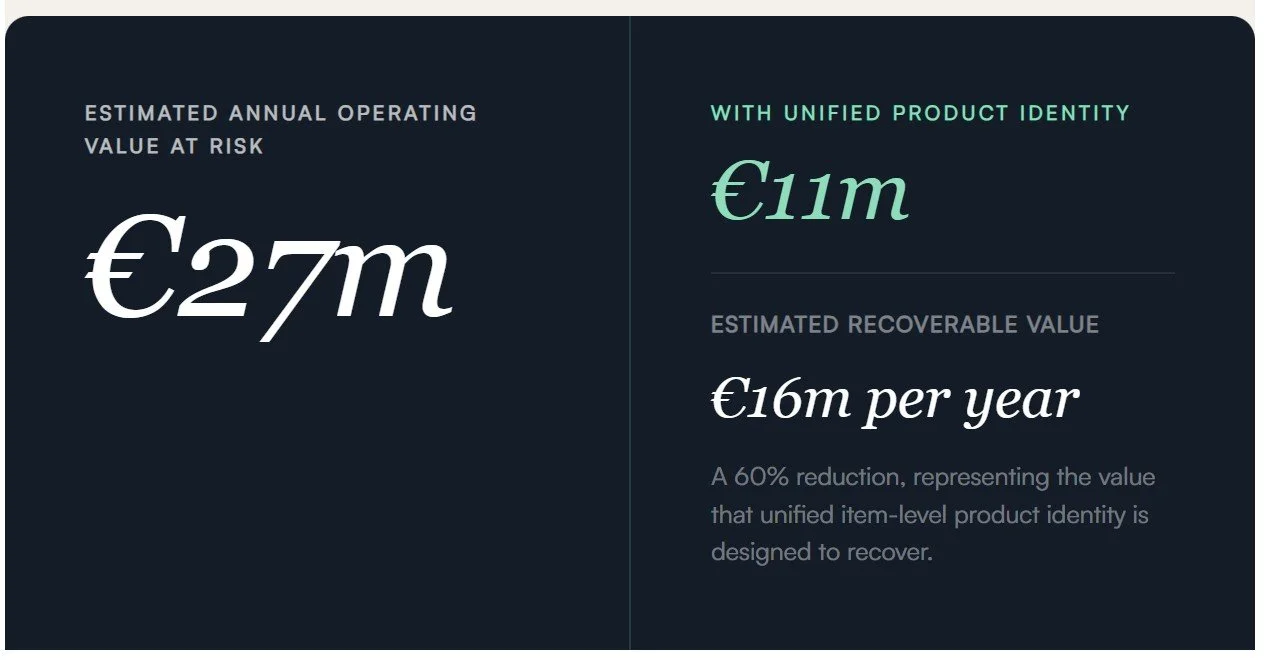
c. €20m
For a typical premium consumer goods or luxury company, this much annual operating value can remain unrealised when product identity is fragmented. The cost rarely appears as one obvious failure. It builds across margin leakage, service inefficiency, inventory drag and duplicated reconciliation.
See how this applies to your business
The four decisions leadership must take
To avoid fragmentation and retain control, leadership must decide four things early. This is where the report is most direct: product identity is not just a technology issue. It is a structural decision.
1
Define one item-level identity
One governed identity per product, used across the lifecycle.
2
Govern it centrally
Ownership must sit at enterprise level rather than within one function, pilot or vendor relationship.
3
Separate identity from technology
QR, RFID, NFC and other enablers must point to the same identity rather than create competing ones.
4
Integrate it into core systems
Identity must connect to operational systems before use cases scale.
Where unified product identity creates value
When identity is unified, value begins to appear across three operational levers. These are the levers the report returns to throughout: control, availability and trust.
Control
Earlier diversions detection
Reduced leakage
Less audit reliance
Outcome: Margin protection
Availability
Observed movement
More precise allocation
Lower stock-outs and markdowns
Outcome: Revenue and working capital protection
Trust
Verified product history
Fast after-sale
Resale enabled
Outcome: Secondary revenue and service margin
What you will learn
Four areas where early decisions shape whether product identity becomes infrastructure or fragments across systems, functions and partners.
The decisions that are hard to reverse
How early choices on identity, ownership and pilots determine long term control.
What unified identity unlocks
How organisations move from delayed reporting to real-time product signal, automation and AI.
Where value is already being created
How leading organisations improve availability, detect diversion earlier and make trust verifiable.
What leadership must decide
The non-delegable decisions that shape ownership, governance and lifecycle control.
Who this is for
Senior leaders responsible for digital, supply chain, customer experience and transformation. Particularly relevant for organisations managing complex distribution, high value products or resale and service models.
Expert Contributors
Featuring leaders from LVMH, Diageo, Pernod Ricard, Coty, Decathlon, Moët Hennessy, Salomon, GS1 and Aura Blockchain Consortium.
-

Benoit Aubas
LVMH, Group Web3 Lead
-

Gaël Demenet
Decathlon, Global VP Data & Analytics Customer Growth & Sports Experiences
-

Ian Curd
Diageo, Connected Data Foundations Lead Global
-

Nicolas Comestaz
Coty, Vice President Global Data & AI CoE
-

Maël Tannou
Pernod Ricard, Supply Chain and Customer Service Director
-

Luis Freitas
Moët Hennessy, Senior Director Digital RTC & E-Commerce
-

Nicolas Belie
Salomon, Head of Data Platform
-

Camilla Young
GS1 UK, Programme Lead - Next Generation of Barcodes
-

Davide Di Stefano
Aura Blockchain Consortium, Partnerships & Business Development Manager
-

Cédric Lecolley
GS1 France, Sales & Community Engagement Director

Download the report
Understand how leading organisations are structuring unified product identity, and the decisions that determine control, margin and trust.
Enter your details to receive the report and occasional updates from us. You can unsubscribe at any time.
What might this already be costing your business?
Our Product Identity Exposure Assessment is a short assessment designed to help you explore where fragmented product identity may already be weakening control, margin and trust in your business.
About the collaboration
This research brings together two complementary perspectives on product identity:
Selinko (Toppan) enables secure, persistent product identity embedded in the product itself.
Pivot & Co helps organisations design how that identity works across systems, functions and lifecycle.
Together, we support organisations in turning product identity into a scalable foundation for control, service and future value.